Boiler Losing Pressure? How to Tell If You Have a Central Heating Leak
Boiler pressure dropping week after week? How to tell a central heating leak from a faulty vessel, where leaks hide and when to book a plumber or heating engineer.
If your boiler keeps losing pressure and you have to top it up every few days, you probably have a central heating leak or a faulty expansion vessel or relief valve. Check radiator valves, pipe joints and the pipe under the pressure relief valve for water. If you find nothing, the leak may be under a floor or inside the boiler. Boiler internals need a Gas Safe engineer. A hidden pipe leak can be traced without lifting floors.
Key Takeaways
- A sealed system should hold its pressure. Frequent top-ups mean water is escaping or the vessel has failed.
- Check radiator valves, joints, the pressure relief outlet and the boiler for drips.
- A pressure drop with no visible wet can mean a leak under floorboards or a slab.
- Do not keep topping up and ignore it. It floods the system with fresh water and corrodes it.
- Work inside the boiler is for a Gas Safe engineer only.
If your boiler keeps losing pressure and you have to top it up every few days, water is escaping from the system or a part such as the expansion vessel or relief valve has failed. Look for drips at radiator valves, pipe joints and the pressure relief outlet. If you cannot see anything, the leak may be under a floor or inside the boiler, and it needs tracing rather than guessing.
What is normal boiler pressure?
Most sealed combi and system boilers sit at roughly 1 to 1.5 bar when cold and rise a little when hot. Your boiler manual gives the correct range for your model. A sealed system should hold its pressure for weeks. If it drops below the minimum mark and the boiler shows a low pressure fault, something is wrong. Our guide to how to repressurise a boiler explains the safe way to top up, and causes of a boiler losing pressure goes through the common faults in more detail.
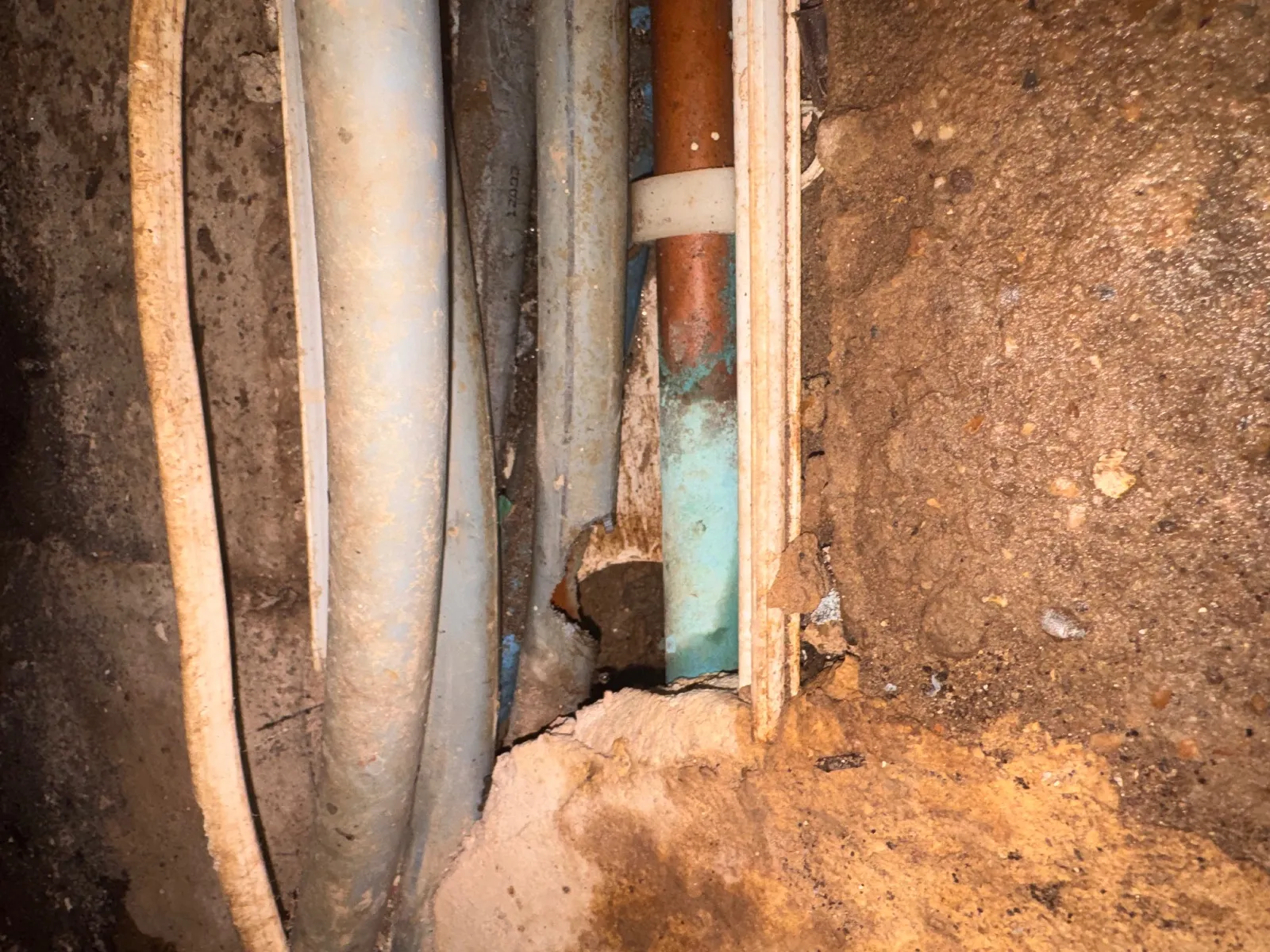
Where central heating leaks hide
| Where to look | What you might see |
|---|---|
| Radiator valves and joints | Damp at the spindle or union, a stain on the carpet, rust marks |
| Radiator body | Corrosion spots or a wet patch at the bottom |
| Pipes in cupboards and airing cupboards | Green or white crust at joints |
| Pressure relief valve outlet | Drips from the small pipe outside the wall |
| Boiler casing and pump | Water underneath, which needs a Gas Safe engineer |
| Pipes under floors | Nothing visible, or a warm patch or damp smell |
A leaking radiator is one of the easier problems to fix. See our guide on leaking radiators for what to try first.
When it is not a leak
Sometimes pressure drops with no escape of water from the pipes:
- A failed expansion vessel. It loses its air charge, so the pressure rises when hot and the relief valve discharges. Read expansion vessel problems.
- A pressure relief valve that is weeping. Water leaves through the discharge pipe, often outside.
- A recently bled radiator. Letting air out drops the pressure, so top it up once.
- A fault inside the boiler. For example a leaking heat exchanger or a failing diverter valve. This needs a Gas Safe engineer.
Central heating leak detection
If you have checked the radiators and joints and the pressure still falls, the leak is probably hidden. A survey can isolate sections of pipework and pressure test them, listen for the leak and use thermal imaging to find warm or wet pipe runs. That avoids lifting floors at random. Our leak detection service covers this. If the leak is under a floor, leak under a floor or slab: signs and next steps explains what happens next.
Leak sealer products are sometimes suggested. They can block a pinhole, but they can also clog small passages in a modern boiler or heat exchanger, so ask your engineer before using one.
What it costs
A pressure loss visit often starts with checking the system, the vessel and the valves. Pinpointing a hidden pipe leak needs proper detection. Main water leak detection is a fixed £595. A comprehensive investigation is £660: it checks the whole property for all types of leaks, excluding roofs, and includes tracer gas, moisture mapping and pressure testing. Detection by the hour is £180 per hour with the tracer gas bottle included. No find, no fee. No call-out fee when you book the visit in advance. Need someone now? Emergency call-out is £70 and we guarantee someone is with you within one hour. Boiler repairs by a Gas Safe engineer are priced for the fault, and you get the price in writing before repair work starts.
- No call-out fee when you book the visit in advance.
- Need someone now? Emergency call-out is £70 and we guarantee someone is with you within one hour.
- No find, no fee on leak detection.
- Main water leak detection: fixed price £595.
- Comprehensive leak detection investigation: £660. It checks the whole property for all types of leaks, excluding roofs, and is all-inclusive: tracer gas, moisture mapping, pressure testing and so on.
- Leak detection by the hour: £180 per hour, tracer gas bottle included.
- Plumbing repair work (not detection) is £95 per hour, and the £60 call-out is waived over 2 hours.
- You get a written price before any repair work starts.
- Gas work is done by Gas Safe registered engineers.
- We answer 24/7 on 020 7870 3200.
When to call a plumber
Call if you are topping up more than once a month, if the boiler shows a low pressure fault again within days, if the relief valve is dripping, or if you notice damp or a warm patch on a floor. Call 020 7870 3200, any hour, or use the contact page. For a heating-specific enquiry, see our boiler pressure page.
Topping up the boiler every week?
Call us. We will check where the water is going and let you know whether it needs a leak trace, a new part or a boiler engineer.
Call 020 7870 3200Or send us the details, see pricing or read about our leak detection service.
Frequently Asked Questions
Why does my boiler keep losing pressure?
The usual causes are a leak on the heating system, a faulty expansion vessel, a pressure relief valve that is discharging or a fault inside the boiler. Check for drips first, then note how fast it falls.
How much pressure loss is a leak?
A sealed system should hold its pressure for weeks. If you have to top it up every few days, treat it as a problem. A small seasonal change as the system heats up is normal. Check your boiler manual for its working range.
Can a central heating leak be under the floor?
Yes. Heating pipes run under floors in many London homes, and a pinhole leak can lose a little water at a time with no visible stain. A survey can pressure test and trace the pipe.
Is it safe to keep topping up the boiler?
As a short-term measure, yes, if you follow the filling loop instructions. Doing it repeatedly adds fresh water and air, which speeds up corrosion. Find the cause.
Do I need a Gas Safe engineer for a pressure problem?
For anything inside the boiler, yes. A plumber can deal with pipes, radiators and valves, but gas appliance work must be done by a Gas Safe registered engineer.
Sources and further reading
Source links checked 3 November 2026. Scheme rules and manufacturer instructions can change; use the current official guidance for your account or exact appliance.